• Skip to primary navigation
  • Skip to main content
Reef Catchments Three Colour PMS
  • About
    • Annual reports
    • CEO’s Message
    • Board members
    • Our team
    • Careers
    • Partners
    • Queensland NRM Network
    • Strategic plan
    • Become a member
    • Update your contact details
  • Projects
    • Sustainable Agriculture
    • Waterways
    • Biodiversity
    • Great Barrier Reef
  • NRM Plan
    • NRM Plan 2014-2024
    • NRM region map
    • NRM Plan supporting documents
  • News
    • Articles
    • Newsletters
    • Media releases
    • Citizen Science Calendar
  • Events
  • Resources
    • Species, ecosystems & pests
  • Get involved
  • Careers
  • Contact us
×
  • About
    • Annual reports
    • CEO’s Message
    • Board members
    • Our team
    • Careers
    • Partners
    • Queensland NRM Network
    • Strategic plan
    • Become a member
    • Update your contact details
  • Projects
    • Sustainable Agriculture
    • Waterways
    • Biodiversity
    • Great Barrier Reef
  • NRM Plan
    • NRM Plan 2014-2024
    • NRM region map
    • NRM Plan supporting documents
  • News
    • Articles
    • Newsletters
    • Media releases
    • Citizen Science Calendar
  • Events
  • Resources
    • Species, ecosystems & pests
  • Get involved
  • Careers
  • Contact us
Hide Search

Archives for March 2026

Growing Community Stewardship for Seagrass in the Whitsundays

jamie · Mar 27, 2026 · Leave a Comment

Over the past 18 months, the Upscaling SeaGrow project has been strengthening seagrass restoration and community stewardship in the Whitsundays.  

Building on earlier research by Central Queensland University (CQU), who trialled innovative seed-based restoration techniques, the project saw seagrass seed-balls deployed across a priority site in Pioneer Bay.  

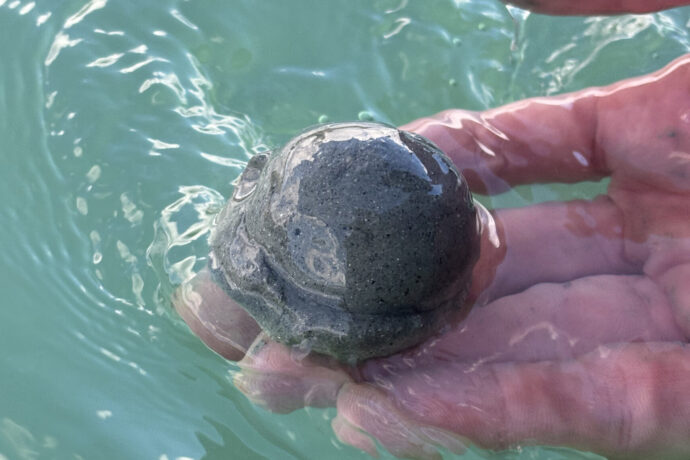
“Seed-balls are a simple and effective restoration tactic that CQU have trialled” says Reef Catchments Senior Project Officer, Morgan Thomas. “The seedballs are made using sticky sediment collected from around the mangroves and Zostera Muelleri seeds collected by volunteers at Cannonvale Beach. Because the sediment is so sticky, CQU are able to drop the seedballs into priority areas where we want seagrass to grow with relative precision and know that the balls will stay there long enough for the seeds to anchor to the meadow floor, grow and hopefully thrive.” 
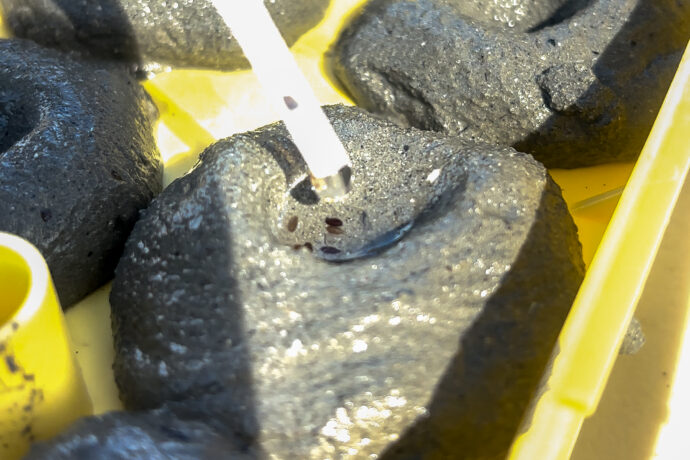
close up image of seagrass seeds being dropped into a hollowed-out ball of sediment to make a seedball
Seagrass seeds being dropped into mangrove sediment to create a seedball
hand holding seedball into water to be dropped into the meadow
Seedball being deployed at Pioneer Bay

But ecological restoration was only one part of the story. At its core, SeaGrow was designed to connect community members with local restoration efforts, turning curiosity into capability and participation into stewardship. 


Creating Space for Community to Lead

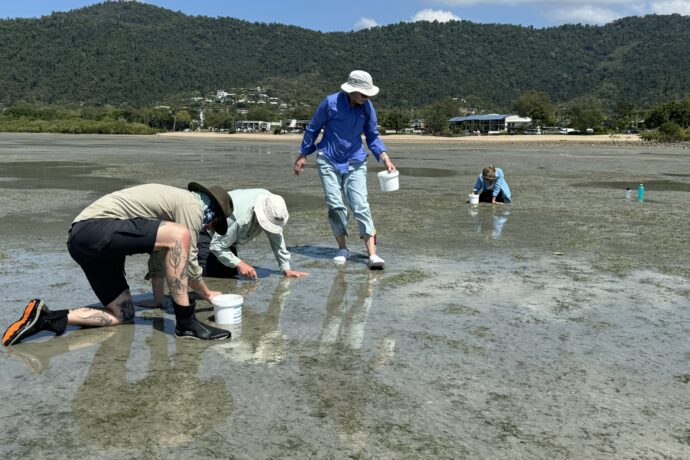
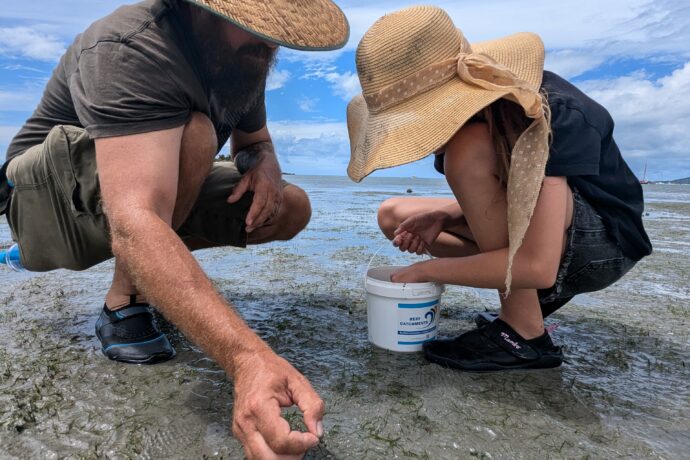
A strong focus was on community engagement through training workshops and flower collection events, allowing residents, visitors and local stakeholders to connect directly with local seagrass habitats and the important restoration work being done in the region. By removing barriers to involvement, the project highlighted a clear way forward: empowering local stewardship is essential for scaling marine restoration. Participants walked away with a deeper understanding of seagrass ecosystems, the challenges they are facing and the role that individuals can play in supporting their recovery.  

Jane, one of the project’s champion community members, noted, “Most people do care, its just knowing how to help.”   

For many, this was their first opportunity to engage directly with marine restoration, helping to build confidence and demonstrate that meaningful contributions are accessible at a local level. 
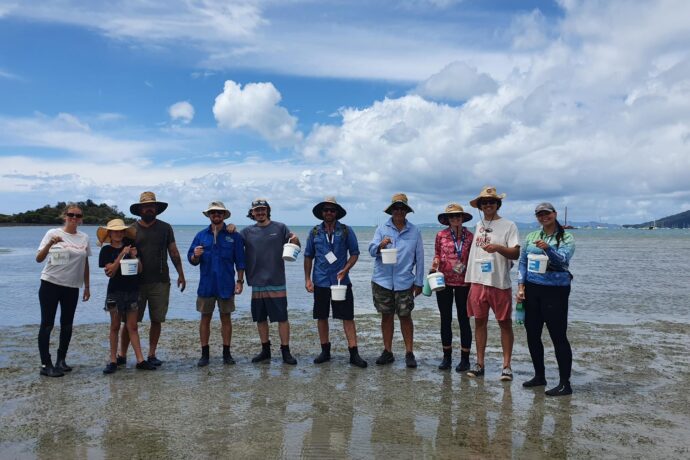
The ripple effects of this community-centred approach extended far beyond the project itself. Participants gained practical skills, increased awareness and, in some cases, went on to engage with other conservation initiatives across the region.  

These outcomes highlight the value of creating simple, hands-on entry points that not only support immediate projects goals but also contribute to longer-term stewardship by empowering individuals to stay involved in caring for the local environment. Volunteer feedback from community events was overwhelmingly positive, with 85–96% of participants reporting improved knowledge, confidence and motivation to care for seagrass. Surveys also recorded major knowledge gains, including a 137% increase in understanding of local seagrass species. 

As one project participant reflected, “I discovered the important role of seagrass. I learnt about different kinds of seagrasses. I can now educate others and inspire/motivate others.”   


Tourism Operators: Champions for Restoration

A standout element of the project has been the assistance of local tourism operators, who supported the project by providing boating access to restoration sites at high tide. This collaboration allowed researchers from CQU to engage with community members directly on their boats, creating opportunities for connection even when formal events were not running. By keeping this work visible and most importantly, accessible, these tourism operators helped demonstrate the potential to transform seagrass restoration from a single project activity into an ongoing community experience, enabling visitors and locals alike to learn, observe and take part in stewardship over time.  

Dale from Whisper Bay Cruises noted the excitement generated by the on-the-water interactions, saying, ”Once people are aware of the seagrass and its importance, they are really excited by it.” 

These collaborations demonstrate how tourism can evolve from a passive observer of the environment to an active partner in its protection. By integrating restoration into everyday tourism experiences, the region is creating powerful opportunities for visitors and locals alike to witness and engage with stewardship in real time. 

Reef catchments project officer deploying a seedball off a boat
Reef Catchments Project Officer Alexandra (Lexi) Williams deploying a seedball onboard the Whisper Bay Cruise


A Strong Foundation for the Future

Upscaling SeaGrow (Whitsundays) has shown that meaningful stewardship can grow quickly when people are invited in, supported and inspired. While restoration methods like seed-ball deployment provide a practical foundation, the project reinforces a bigger truth: that long-term impact relies on people – sustained engagement, accessible pathways for involvement, and collaboration across community, tourism and Traditional Owner groups. The relationships built, skills developed and community interest sparked over the past 18 months form a strong foundation for future efforts, reinforcing that scaling seagrass restoration in the Whitsundays will depend on continuing to invest in the people connected to these ecosystems. 

The seeds planted – both literally and figuratively – are already taking root. With ongoing community enthusiasm, the region is well‑positioned to grow a powerful, lasting culture of marine stewardship. 
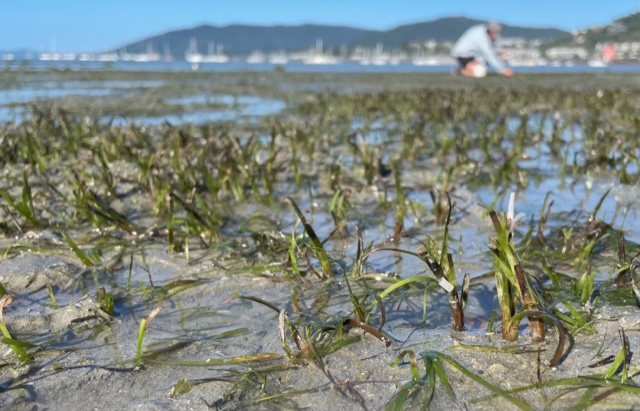
close up of seagrass in the mud at cannonvale beach

Seagrass restoration and research in the Whitsundays is delivered by CQUniversity, Reef Catchments, and OzFish Unlimited in partnership with the community. The project is funded by the Great Barrier Reef Foundation’s Reef Islands Initiative, which is supported by Lendlease, the Australian Government’s Reef Trust, the Queensland Government, and the Fitzgerald Family Foundation.   
Turning Waste into Wealth: Seaweed and Circular Economy Innovations for Queensland’s Reef

jamie · Mar 26, 2026 · Leave a Comment

Imagine if seaweed, once seen as waste, became the key to cleaner water and a thriving circular economy. 

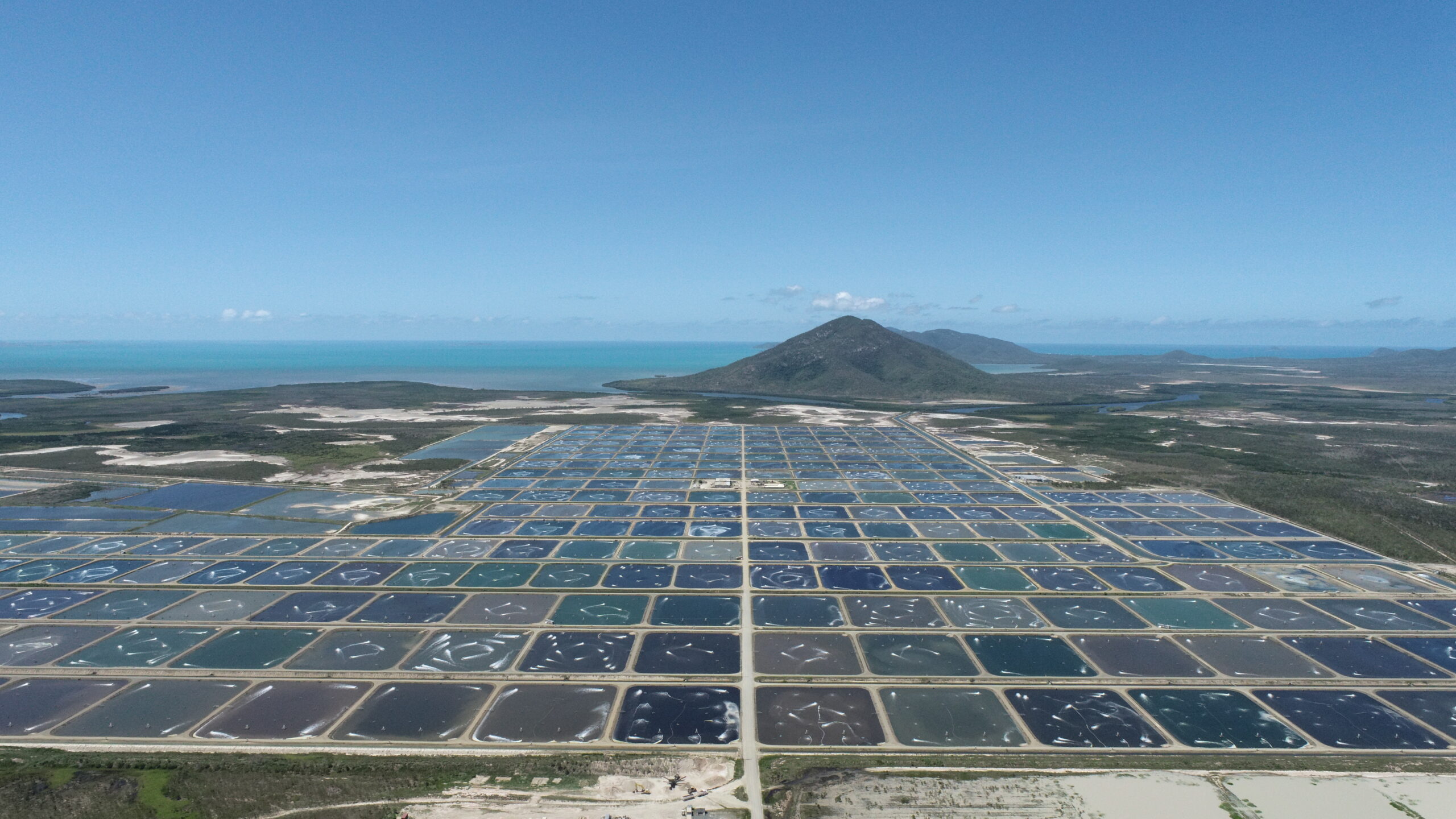
That’s the vision driving Reef Catchments’ innovative Biofiltration Solution project – part of the Proserpine Integrated Project (PIP), delivered in partnership with Tassal and supported through the Queensland Government’s Reef Water Quality Program. 


Using Seaweed to Clean Water and Create New Value 

At Tassal’s Proserpine Prawn Farm, a groundbreaking trial is underway exploring how green seaweed (Cladophora) can act as a natural biofilter. By absorbing excess nutrients from wastewater, the seaweed helps improve water quality before it reaches local waterways and, ultimately, the Great Barrier Reef. 

Early research shows promising potential: the system may remove 7.6 to 11.7 tonnes of dissolved inorganic nitrogen (DIN) each year, positioning seaweed as a powerful nature‑based tool in reducing nutrient loads. 

Reef Catchments’ Manager – Sustainable Agriculture, Todd McNeill, says this approach represents a shift in how the aquaculture industry views “waste.”  

“This project provides the first step in supporting Research  to develop marketable seaweed by-products and explore its potential as a resource for regional circular economy initiatives, strengthening the region’s value chain. Aquaculture seaweed waste presents exciting opportunities to create high-value products – such as animal feed, fertilisers, biochar, bioplastics, and bioactive extracts – turning what was once a by-product into a driver of innovation, sustainability, and new revenue streams”, Todd McNeill explains. “We recognise that while different seaweed species have unique attributes and constraints, these characteristics also offer diverse opportunities for innovation and value creation.”


arerial shot of the tassals prawn farm in proserpine


A Place-based Approach to Innovation 

Delivered through a collaborative partnership between Reef Catchments, Tassal and the Queensland University of Technology (QUT), the project aims to build an evidence base to support long‑term growth in seaweed‑based wastewater treatment and product development. 

Tassals Senior Technician – Bioremediation, Maddy Smith, says the trial is already delivering valuable insights: 

“Partnering on this project allows us to explore how a natural by‑product could become a valuable resource while supporting cleaner water for the Reef. This is the kind of forward‑thinking, science‑led innovation we’re committed to driving across Tassal’s aquaculture operations.”

She explains that while trial is ongoing, the team is learning a great deal about how Cladophora performs in real-world conditions:

“While the trial is still underway, it’s already giving us valuable insights into where seaweed may fit within our broader wastewater treatment approach. We’re assessing how Cladophora performs on site and what that could mean for nutrient management. It’s a promising area of research, and we’ll continue refining and validating results as the project progresses.”


Driving Scalable, Sustainable Change for the Reef and the Region 

As the region’s Natural Resource Management (NRM) organisation, Reef Catchments is committed to advancing environmental, social, and economic outcomes through responsible, evidence‑based natural resource management. Through a place‑based research and development approach, the Circular Economy project is laying the groundwork for seaweed farming to become a commercially viable and environmentally sustainable component of Queensland’s aquaculture industry. 

Delivered by Reef Catchments and supported by Tassal, this initiative forms part of the $5.5 million Reef Place‑Based Integrated Projects program, funded through the Queensland Government’s Queensland Reef Water Quality Program. 

By combining innovative circular economy thinking with sustainable aquaculture practices, the project is helping the sector strengthen its environmental performance while supporting cleaner water for the Great Barrier Reef. The ongoing testing and refinement of wastewater treatment and seaweed production systems are producing practical, scalable solutions with potential application across Australia. 

Throughout the project, Reef Catchments and its partners will continue sharing insights including successes, challenges and lessons learned to build a strong evidence base that encourages broader industry adoption. This work is helping drive new opportunities for sustainable aquaculture and circular economy growth across the Mackay–Whitsunday–Isaac region and beyond. 

Circular thinking. Coordinated action. Shared value. 

jamie · Mar 25, 2026 · Leave a Comment

For years, Natural Resource Management (NRM) organisations have worked to improve water quality at the end of the chain. This project shows the next step in that journey, connecting water quality with economic change by not only identifying opportunities to recover value upstream, but also helping coordinate the conditions needed for those opportunities to become real.  

Excess nutrients aren’t just an environmental issue, they reveal a system design problem. When nutrients leak downstream, value is leaking upstream.  

The first step of our project was shifting the mindset, helping people see that water quality and lost value are connected, not separate issues. Through the Circular Opportunities for the Proserpine System project, Reef Catchment and our delivery partner Rocio Rutter from Bivio Consulting have been mapping nutrient flows (like nitrogen, pastiches) across aquaculture and sugarcane supply chains, identifying where value and nutrients are lost, and working with industry and government to unlock practical circular pathways that recover value upstream before it becomes pollution downstream.   

We turned the insights from the material flow analysis as intervention hot spots, revealing that aquafeed ingredients and pond metabolic waste for aquaculture, and fertiliser inputs and mill outflows for sugarcane where areas of circular opportunity. 

Todd McNeill, Reef Catchments Manager for Sustainable Agriculture, says: “Turning local industries into circular solutions for bigger, lasting regional impact is crucial to make our region economically and environmentally sustainable and connected.” 

Our most recent workshop brought together diverse stakeholders from industry, government and research to explore where value and nutrients are lost, build a shared understanding of the system barriers holding initiatives back, strengthen coordination across stakeholders, uncover co-benefits, and identify practical steps to strengthen supply chains, cut costs, and improve the environment together.  

Delivery partner Rocio Rutter shared: “The sugarcane industry faces challenges from volatile input prices, mills are under throughput pressure, stricter environmental rules, stranded energy, costly waste, and ongoing nutrient runoff. The Mackay Whitsunday Isaac region is full of circular ideas – but progress is held back by fragmentation and system-level barriers.” 

Progress is held back by a combination of system-level challenges which are: 

  1. Capital access – Funding supports initial concepts and pilots, but not the scale-up and coordination needed for real impact. 
  1. Market and offtake – Uncertain demand for circular products, no access to staged off-take, and many operations are not ready to integrate them. 
  1. Risk and value flow – Hesitation due to unclear returns, shared risks, or misaligned incentives. 
  1. Input feedstock – Variability in the supply of materials, and no shared infrastructure to collect and pre-process them for circular use. 
  1. Infrastructure and logistics – Fragmented systems, limited transport options, and gaps in coordination. 

Through this project, Reef Catchments seeks to support the Mackay Whitsunday Isaac region to reduce nutrient runoff, save money, create new opportunities (or support the scale of existing ones), and help our region grow. By looking at the whole system, we’re helping farms, industry and the environment thrive. 

With global shocks already affecting fertiliser supply and farm costs, building domestic circular alternatives from local resources is no longer a nice-to-have; it’s a resilience priority we must work on together. 

AI in the Cane: Reducing Labour, Cutting Costs and Safeguarding Proserpine Waterways

jamie · Mar 23, 2026 · Leave a Comment

Proserpine sugarcane growers are leading the way in adopting smart technology that solves the dual challenge of rising pesticide cost and labour shortages. Through the Proserpine Integrated Project (PIP) AutoWeed project, Reef Catchments is working alongside researchers from James Cook University to deliver on-ground results that make practical, profitable sense for local farms while sustaining the long-term health of our waterways.  

The project’s first trial at Kelsey Creek has proven that we can match the 95%+ weed control of blanket spraying while significantly reducing herbicide runoff. By using Artificial Intelligence (AI) to target weeds with precision, growers can cut chemical use by up to 80%, securing better outcomes for both the paddock and the catchment 

“By only spraying where the weeds are, we cut herbicides and costs while protecting our waterways,” says Lead project researcher Associate Professor Mostafa Rahimi Azghadi. “The Reef wins, and growers win.” 

Why it Matters for Water Quality: 

  • Reduced Runoff: Direct proportional reduction between herbicide sprayed and concentration in runoff. 
  • Measured Impact: Early results indicate a 46% reduction in chemical concentration in water runoff. 
  • Scalable Solutions: Data collected during this trial improves accuracy for widespread regional adoption across the Mackay Whitsunday Isaac region.  
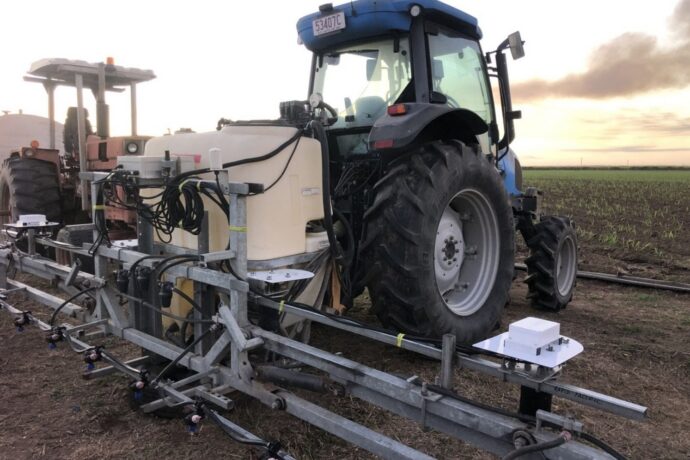
3-row self-propelled sprayer on a Burdekin sugarcane paddock,
3-row self-propelled sprayer on a Burdekin sugarcane paddock, photo courtesy of AutoWeed’s Alex Olsen
Autoweed Ai sprayer in action on a farm in the Burdekin
The AutoWeed AI sprayer, co-developed by JCU, in action on a farm in the Burdekin

The Autoweed project is funded through the Queensland Government’s Queensland Reef Water Quality Program and delivered by James Cook University in partnership with Reef Catchments under the Proserpine Integrated Project.

Resilient Catchments Register

Share your knowledge. Register your idea. Shape the future of our land, sea and waterways.

Register now

Get to know us better

You’ll receive our monthly newsletter containing updates on events and workshops, community activities and information about how our projects are helping our regional environment and communities.

  • This field is for validation purposes and should be left unchanged.

© 2026 Reef Catchments · All rights reserved · Site by the dma

  • Disclaimer
  • Privacy Policy
  • Sitemap
  • Contact
  • Disclaimer
  • Privacy Policy
  • Sitemap
  • Contact
Reef Catchments would like to acknowledge the Traditional Owners, past and present, on whose land, sea and waters we work. We acknowledge their enduring spiritual and cultural connection and their responsibility as First People to maintain and care for Country.
While every effort is made to maintain a culturally respectful resource; Aboriginal and Torres Strait Islander people are advised that this website may contain images, voices and names of people who have passed away.