
The Project
Title: Reducing pesticide use using Smart spraying to save costs and reduce herbicides.
Duration: 2025 – June 2027
Funding: The Autoweed project is funded through the Queensland Government’s Queensland Reef Water Quality Program and delivered by James Cook University in partnership with Reef Catchments under the Proserpine Integrated Project.
Summary
As part of the Proserpine Integrated Project (PIP), this project explores the possibility to – Spray Smart, Cut Costs, & Reduce Risk through Artificial Intelligence (AI). The collaboration between Reef Catchments, James Cook University, AutoWeed, Sugar Research Australia, and the Queensland Department of Primary Industries combines advanced technologies—including artificial intelligence, image processing, and remote sensing—to reduce pesticide use in sugarcane farming.
The Autoweed project includes a zonal pre‑emergent trial guided by drone mapping and AI‑generated spray prescription maps. This technology will be applied to the region’s unique conditions and its priority weeds to support water quality improvement in the Proserpine Catchment and the health of the Great Barrier Reef.
Building on previous research, the project aims to achieve the following:
Objectives:
- Conduct targeted spray trials for high priority weed species.
- Develop place-based AI weed detection algorithms.
- Demonstrate the technology’s environmental and economic benefits.
Outcomes:
- Targeted Spot-Spraying to Reduce Herbicides
- AI-driven AutoWeed technology to precisely target weeds with knockdown and pre-emergent herbicides.
- Reduction in blanket spraying, directly lowering the volume of chemicals applied and running off farm
- Weed Mapping for Smarter Application
- High-resolution drone and ground imagery, coupled with advanced AI models, will generate precise weed maps.
- Maps enable zonal and spot applications, preventing unnecessary pesticide use and reduce chemical loads
- Quantified Water Quality Benefits
- Herbicide reduction data analysis in the Pesticide Projector tool will provide tangible, measurable evidence of reduced herbicide runoff, demonstrating the linkage between technology adoption and water quality improvements.
- Scalable Environmental Impact
- Tailored AI models designed to suit local conditions will support increased industry interest and uptake.
- Widespread use of this technology across farms could significantly reduce cumulative herbicide runoff, improving long-term water quality outcomes for the region.
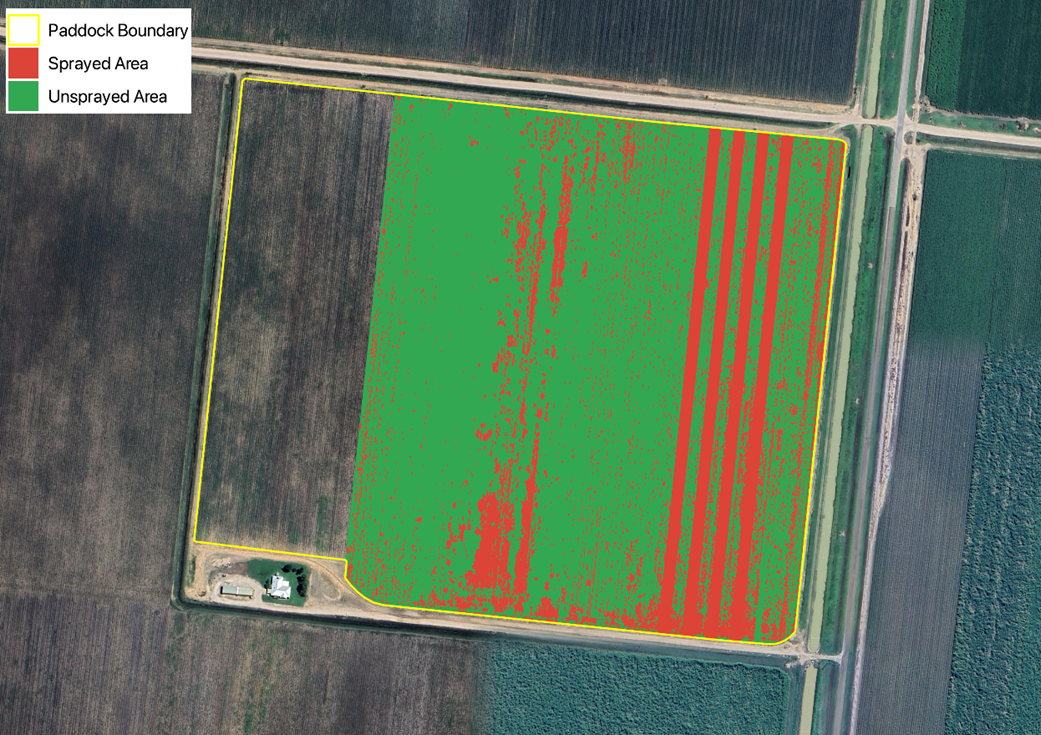
Cane paddock where AutoWeed targets nutgrass, achieving 99% of the effectiveness of blanket spraying while reducing herbicide use by 89%.
Red rows mark areas treated with standard blanket spraying, while green rows indicate where AutoWeed maintained control that would otherwise have required blanket spraying.
Current Projects
This project, delivered by Reef Catchments is part of the $5.5 million Reef Place-Based Integrated Projects initiative funded through the Queensland Government’s Queensland Reef Water Quality Program.

