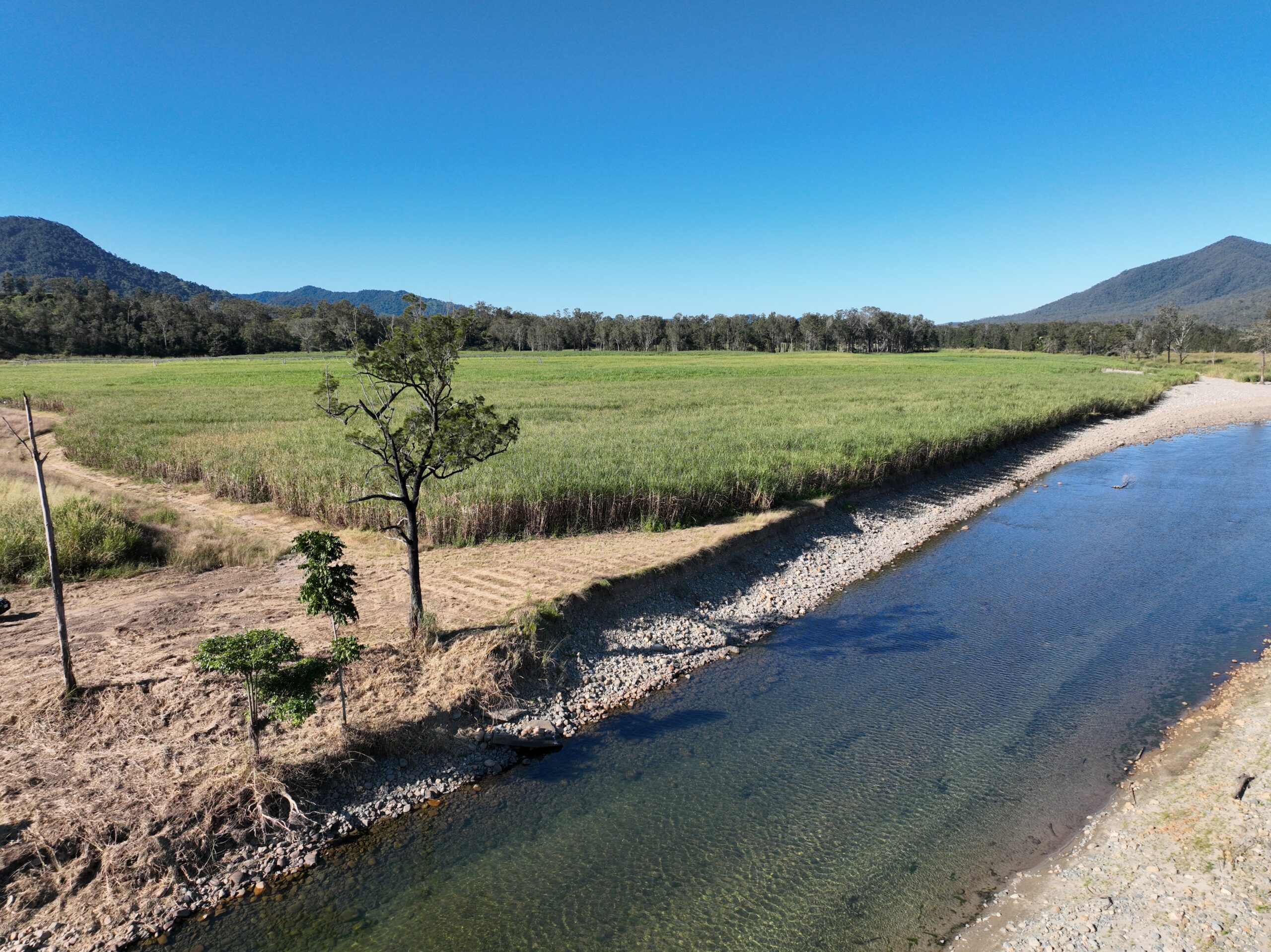
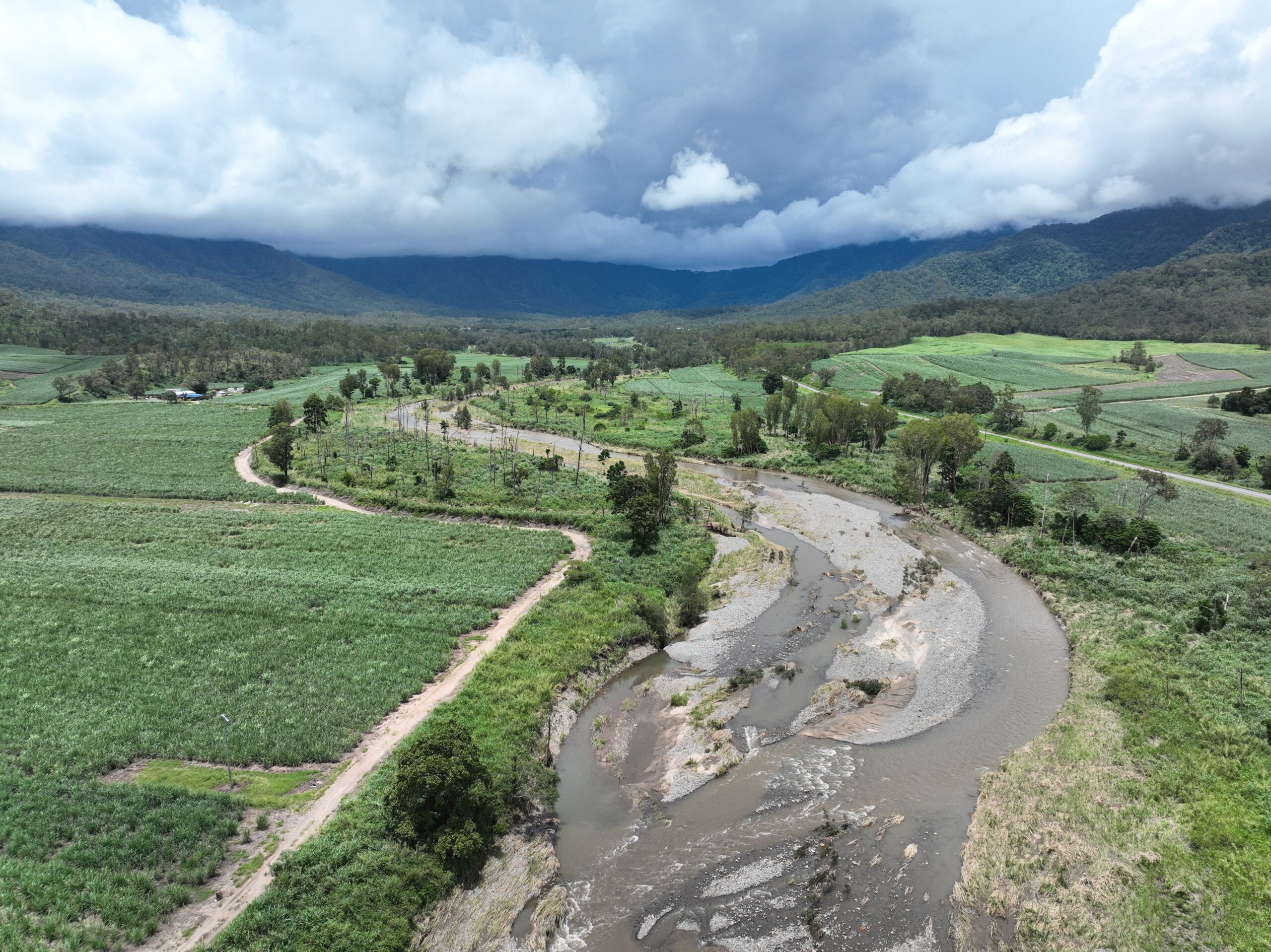
Cattle Creek moves quickly. Rising in the Clarke Range, it flows east through Finch Hatton into the Pioneer River, one of the region’s most flood‑prone systems. The Bureau of Meteorology notes frequent flash flooding; when rain falls, water levels rise fast and the creek actively cuts into its banks.
For years, that has reshaped the landscape. Repeated flooding has driven ongoing erosion, with productive paddocks gradually lost as banks fail season after season. Landholders consistently raised the impacts – land loss, instability and declining water quality – but the scale of response needed sat beyond available funding.
This project reflects a shift from issue to action.
Local knowledge defined the problem. Reef Catchments built the evidence to target priority sites, and NRM Regions Queensland (NRMRQ) helped secure the Queensland Government’s $117.84 million investment into regional Queensland landscapes through the Natural Resource Management Expansion Program (NRMEP).
Of that investment, more than $4.8 million is now being delivered on the ground at Cattle Creek.
Five sites across two kilometres of streambank will be stabilised, reducing active erosion, improving water quality and strengthening the resilience of surrounding land. It is the first coordinated riverbank restoration effort in this system in over 20 years. With work now underway, it provides long‑sought support for local landholders.
A system on the brink
The sheer force of Cattle Creek was evident during Severe Tropical Cyclone Debbie in 2017. The Clarke Range received nearly 1 metre of rain in 48 hours, pushing Cattle Creek, Blacks Creek and the Pioneer River into major flood. Reef Catchments later found a clear pattern across the region: where riverbank vegetation was intact, banks held. Where it had been cleared or degraded, as along much of Cattle Creek, erosion was severe and recovery costs were much higher. While Debbie caused $3.5 billion in damage overall, for local landholders the loss was in productive farmland.
In 2018, fire intensified that damage. More than 400 hectares of cane burned in the Pioneer Valley, and flames carried into rainforest. Along Cattle Creek, riparian corridors lost remaining cover and stability, leaving banks exposed and unprotected.
By the 2019 wet season, the system had little resilience left – more or less functioning as a conduit for erosion. Heavy rainfall hit bare, unstable banks with limited capacity to absorb water. Erosion worsened rapidly, and landholders saw productive land collapse into the creek, asking when support would come.
In January 2026, Tropical Cyclone Koji brought up to 700mm of rain to already saturated catchments. Floodwaters surged through Finch Hatton and surrounding areas, and at key sites, banks retreated by up to eight metres in a single event – removing land and resetting recovery efforts.
In just nine years, four major events progressively reduced the system’s capacity to hold together. By 2026, Cattle Creek operated as an unstable, highly reactive system, with erosion driving ongoing loss for landholders.
Multiple voices, one call to action
For years, landholders along Cattle Creek raised the same issue. Through repeated flood events, they have watched banks fail and productive land steadily lost. They understand where flooding occurs, which sections give way and how the system changes over time. This experience shaped the case for action.
Delivering restoration required coordination across community, regional organisations and government. Landholders identified the impacts, Reef Catchments built the evidence, and NRM Regions Queensland worked with regional organisations to secure a program the Queensland Government could fund. Together, this moved a long-identified priority into delivery.
“Cattle Creek is part of the livelihood and family history for many people in the region, and there is a deep concern for maintaining the health of the creek,” said Emma Jones, Principal Project Officer at Reef Catchments.
The project is now being delivered on private agricultural land, with landholders supporting access, guiding works and contributing to long term outcomes.
Glen Kelly MP, Member for Mirani, represents Finch Hatton, Cattle Creek, Eungella and the Pioneer Valley. As a sixth-generation farmer from Kalapa, he brings an understanding of how creek condition affects farms and communities.
When the NRMEP funding for Cattle Creek was announced in November 2025, Glen described it in terms that went to the heart of why the project matters to people in the region rather than just to its environmental metrics.
“From protecting koala habitat to restoring critical waterways, this is the Crisafulli Government backing local solutions and restoring trust in regional investment. Healthy ecosystems mean stronger farming, more resilient communities and better outcomes for future generations,” said Glen Kelly MP.
Enabling investment at scale
NRMRQ, the peak body for the state’s 12 regional Natural Resource Management (NRM) organisations, worked with organisations including Reef Catchments to build the case for expanded investment in Queensland, shaping the NRMEP – structured around the regional organisations already trusted by landholders, councils and communities.
Minister for Natural Resources, Dale Last, was direct about the logic: back the people who know their regions, give them the tools, and get results on the ground.
“This investment is about backing local NRM organisations who know their regions best and giving them the tools to get results on the ground,” said Minister Last.
This approach connects local knowledge, technical evidence and government funding, enabling regionally led delivery of projects like Cattle Creek. NRMRQ’s role has been to build and sustain the policy and funding framework that supports this work, with regional organisations delivering outcomes on the ground and government investing in proven capability.
A pathway to progress
Reef Catchments has been working in the Pioneer catchment for decades, and the foundation for the Cattle Creek project was build though sustained technical work.
Following Cyclone Debbie, Reef Catchments partnered with Neilly Group Engineering to deliver a regional erosion identification, prioritisation and remediation study across the Mackay Whitsunday Isaac region. This work mapped where intervention would deliver the greatest benefit and identified Cattle Creek as a high priority site.
At the same time, Reef Catchments was demonstrating what targeted Natural Resource Management (NRM) investment in this region could achieve. Through Reef Trust programs, Reef Catchments partnered with hundreds of agricultural properties to reduce streambank erosion, lower sediment losses to the Great Barrier Reef, and plant over 100,000 trees to strengthen riparian zones.
The Cattle Creek project builds on that foundation, with established partnerships, proven approaches and technical expertise supporting delivery.
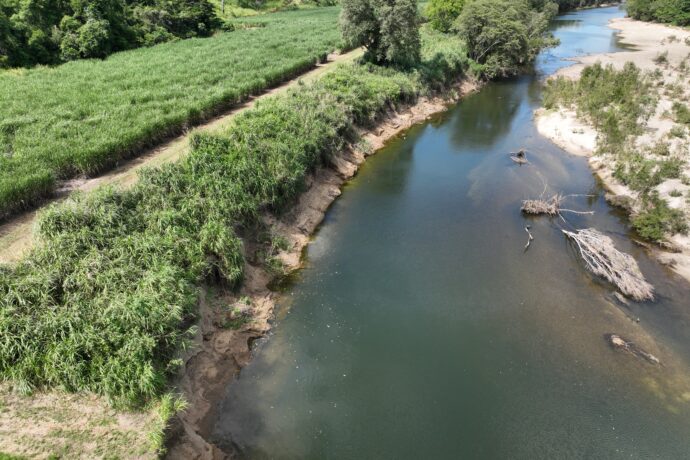
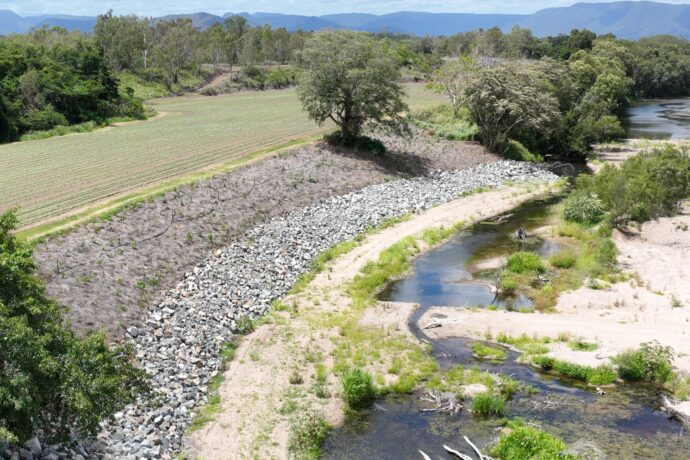
Figure 2 – Before (28/02/2025) and after (19/12/2025) images of similar streambank remediation works funded by the Australian Governement’s Landscape Repair Program in the O’Connell River.
The work on the ground
The Cattle Creek project targets five priority sites across two kilometres of creek. Works include rock armouring to stabelise the most active erosion areas, installation of in-stream woody habitat to slow water velocity and provide refuge for aquatic species including local platypus populations, and planting 10,000 locally sourced native plants grown at Mackay Natural Environment Centre. Construction is being delivered by local contractors, keeping investment within the regional economy.
These works focus on the highest‑risk sections, but erosion extends well beyond the project footprint. Broader catchment data identifies a much larger area of concern, and sediment movement from Cattle Creek into the Pioneer River and Great Barrier Reef lagoon will not be resolved by this project alone.
What this investment provides is a working model at scale. It demonstrates that targeted, reach‑level restoration can stabilise banks, that landholders will partner in delivery, and that measurable outcomes can be achieved. This evidence is critical to informing future investment across the catchment.
Cattle Creek has been a long identified priority. Construction is now underway, shifting the system from sustained impact to active restoration and delivering tangible progress on an issue the community has raised for years. The Cattle Creek project demonstrates the value of local knowledge, strong partnerships and targeted investment in restoring resilient working landscapes.