Beyond Barriers: Mackay and Isaac Coastal Wetland Rehabilitation
A transformative initiative aimed at revitalising two critical coastal wetland ecosystems within the the Mackay Whitsunday Isaac region.
Beyond Barriers: Mackay and Isaac Coastal Wetland Rehabilitation
The Beyond Barriers: Mackay and Isaac Coastal Wetland Rehabilitation project worked to revitalise two critical coastal wetland ecosystems in the Mackay and Isaac regions. By restoring degraded habitats and improving fish connectivity, the project strengthened the ecological health of the Great Barrier Reef catchments and demonstrated what targeted, collaborative restoration can deliver.
Duration: 2024 to 2026
Project Partners: Catchment Solutions, Isaac Regional Council, Mackay Regional Council, Department of Local Government Water and Volunteers, the Koinjmal People / Koinmerburra Aboriginal Corporation, the Yuwibarra / Yuwi Aboriginal Corporation, and local landholders.
Funding: The Beyond Barriers project is one of 18 projects awarded a share of $28.5 million invested by the Australian Government to support restoration of coastal habitats in the Great Barrier Reef catchments. The project is funded by the Australian Government’s Reef Coastal Restoration Program, delivered in collaboration with the Queensland Government’s Department of Local Government, Water and Volunteers.
Project Objectives
The key objectives of this project were to:
Rehabilitate Degraded Wetlands by restoring the ecological function of key coastal wetland ecosystems through on-ground rehabilitation and restoration activities.
Enhance Fish Connectivity by remediating high-priority fish barriers to facilitate the movement of diadromous fish species between freshwater and estuarine systems.
Support Reef 2050 Goals by aligning with the Reef 2050 Plan’s Work Area 5 (safeguard, rehabilitate, and restore) to accelerate progress toward regional water quality targets.
Targeted Sites
The project focused on two high-priority sites identified through the Mackay Whitsunday Fish Barrier Prioritisation Report 2021:
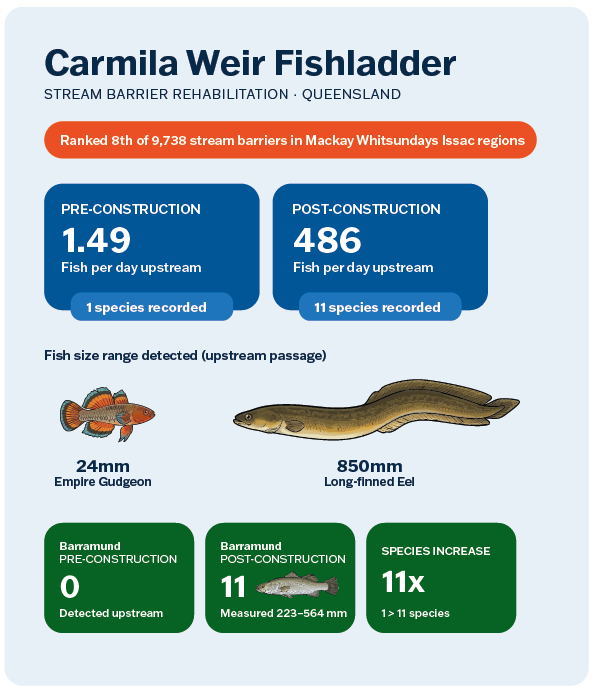
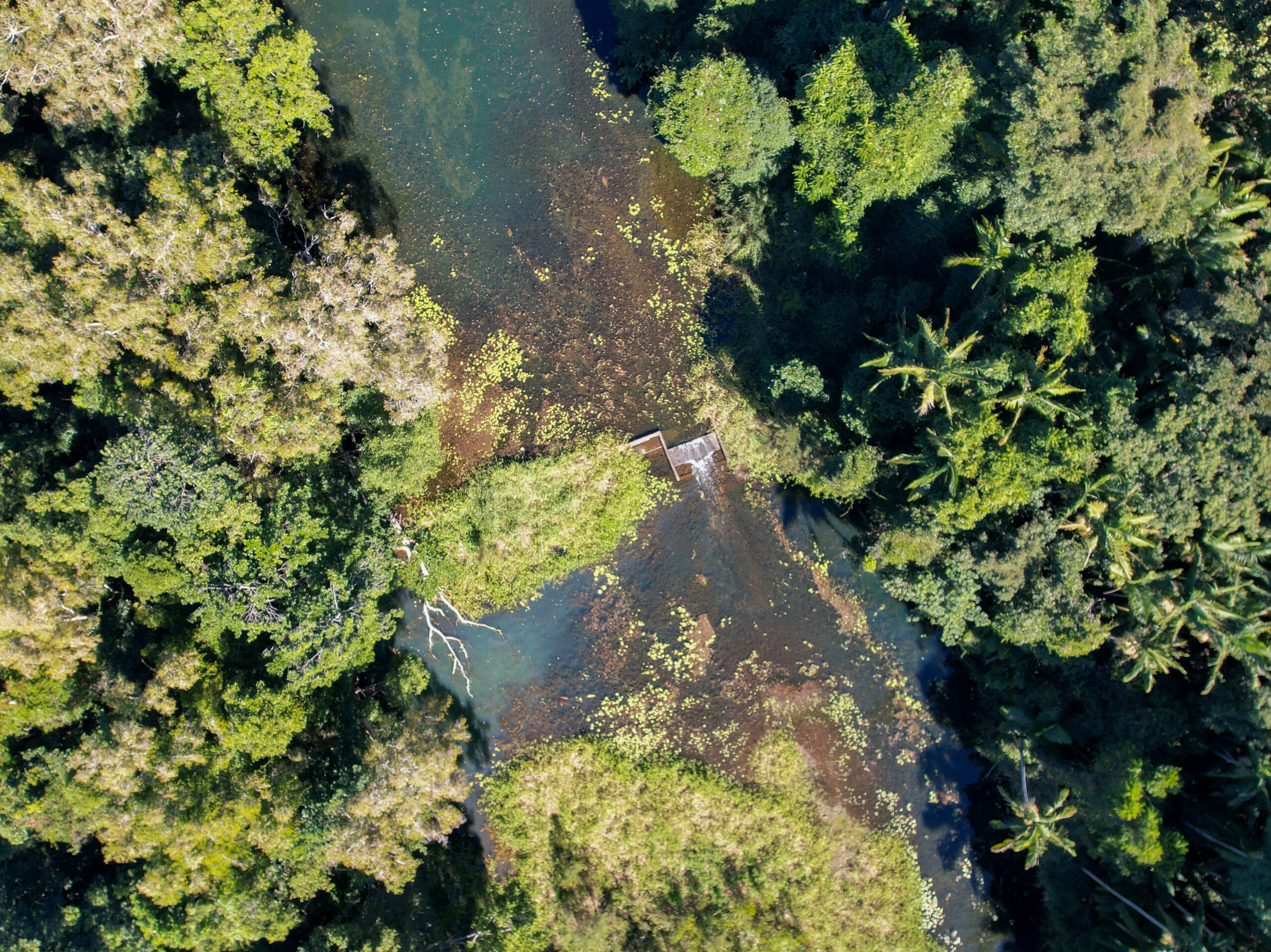
Carmila Creek Gauging Weir: Ranked 8th out of 9,738 potential fish barriers in the Mackay-Whitsunday-Isaac region, this legacy weir had blocked fish movement since the early 1970s. Because the weir serves as both a water gauging station for the Department of Local Government Water and Volunteers and a water source for local cane farming operations, complete removal was not possible. Instead, a fishway was retrofitted into the existing low-flow spillway, restoring fish passage while maintaining the weir’s original functions. The design used prefabricated Nursery Step concrete baffles, a type of fishway new to Australia and specifically intended to improve passage rates for post-larval and juvenile fish with limited swimming ability. Construction ran from September to November 2025.
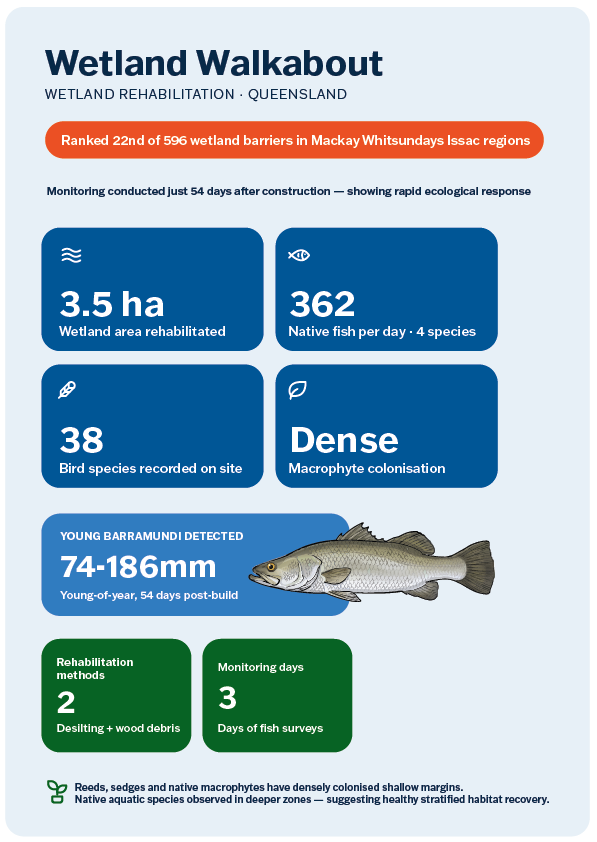
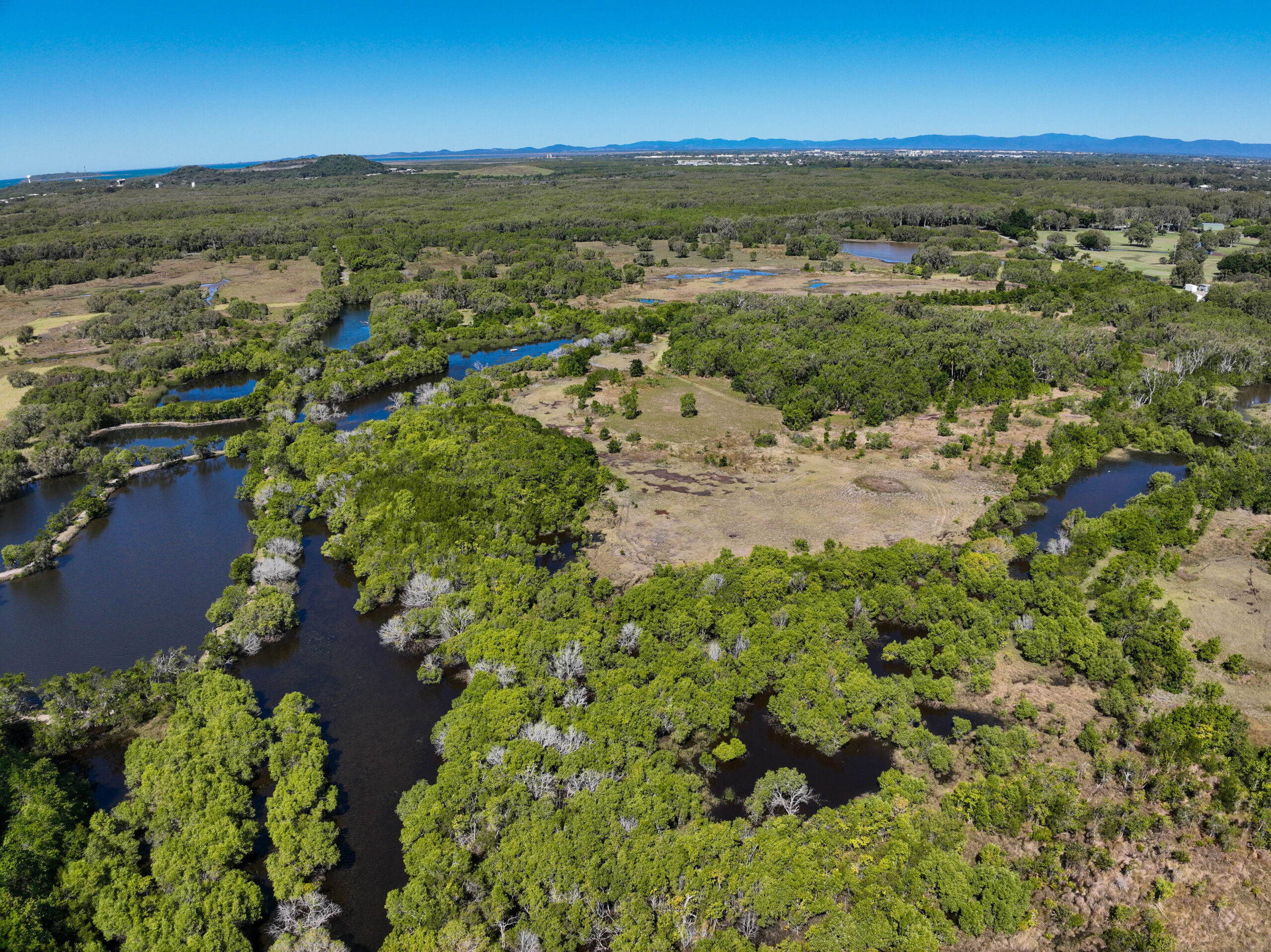
Wetland Walkabout, Mackay: Ranked 22nd out of 596 potential wetland barriers, this 32-hectare private nature reserve in Andergrove forms part of the McCreadys Creek Reserve and encompasses freshwater creeks, lagoons, and estuarine environments. Restoration works were completed in December 2025. Prior to works, a baseline fish community survey in December 2024 found the site in poor condition, with low species diversity, shallow and disconnected habitats, and extremely low water quality at some locations. Works aimed to restore tidal and aquatic connectivity, improve in-stream habitat complexity, and reinstate the site as nursery habitat for key fisheries species.
Project Impact
The project has delivered measurable outcomes at both sites, with native fish species returning to previously inaccessible habitats within months of works being completed.
At Carmila Creek:
A Nursery Step fishway, the first of its kind installed in Australia, was successfully constructed and verified as compliant with all development approval conditions
Post-construction monitoring in April 2026 recorded more than 12 different species migrating upstream through the fishway, including juvenile flyspeck hardheads, rainbowfish, Pacific blue-eyes and empire gudgeons
Barramundi and mullet were recorded using the fishway at night, with several barramundi tagged to enable potential future movement tracking
Freshwater turtles and long-fin eels were also observed using the purpose-built high flow bypass
The restored fishway reconnects upstream nursery and feeding habitats that had been inaccessible since the weir was built prior to the introduction of fish passage legislation
At Wetland Walkabout:
Restoration works were completed in December 2025, improving aquatic connectivity and in-stream habitat across the 32-hectare reserve
Barramundi and other native species returned to the restored wetlands, confirming the site is already functioning as critical nursery habitat for key fisheries species
With improved connectivity, native reed and sedges completely replaced the Olive Hymenache infestation (weed of national significance – WONS) after only 2 months post-rehabilitation activities
Legacy
The return of barramundi and other native species to both sites within months of works being completed reflects the resilience of these systems when connectivity is restored. The success of this project demonstrates how targeted barrier remediation, combined with strong partnerships across government, Traditional Owners, industry and the community, can deliver rapid and lasting ecological recovery.
Ongoing monitoring at both sites will continue to build the evidence base for fish passage remediation in the region, contributing to water quality improvements flowing to the Great Barrier Reef lagoon.
Work is also underway with the Koinjmal People to develop an Indigenous fish activity book for children, showcasing fish species recorded during monitoring at Carmila Weir and promoting the importance of connectivity for healthy ecosystems.
For more information about the Beyond Barriers: Mackay and Isaac Coastal Wetland Rehabilitation project, please contact Reef Catchments Senior Project Officer (Biodiversity) Carlos Bueno.